
8 Amazing Pangolin Facts for Kids
A child spots a strange animal in a picture book and asks, “Is that a pinecone with legs?” That question is a great way to meet one of the most unusual animals on Earth.
The pangolin (say it like this: pan-guh-lin) is a shy, gentle mammal with armor-like scales, a very long sticky tongue, and a big job in nature. These pangolin facts for kids help children and grown-ups learn step by step, from simple body features to the bigger idea of why pangolins need protection, just like Paulie the Pangolin helps make wildlife learning feel personal and warm.
Table of Contents
- 1. Pangolins Are Covered in Protective Scales (Not Fur!)
- 2. Baby Pangolins Ride on Mom's Tail
- 3. Pangolins Have an Extra-Long, Sticky Tongue
- 4. Pangolins Roll Into an Impenetrable Ball for Protection
- 5. Pangolins Are Nature's Pest Control
- 6. There Are 8 Different Species of Pangolin
- 7. Pangolins Are Shy, Solitary, and Nocturnal
- 8. Pangolins Are the World's Most Trafficked Mammal
- Compare 8 Pangolin Facts for Kids
- How Your Family Can Help Save Pangolins
1. Pangolins Are Covered in Protective Scales (Not Fur!)

A child might spot a pangolin for the first time and wonder, “Is that a tiny dragon?” That question makes sense. Pangolins have overlapping scales that look a little like armor, yet they are mammals, and their scales are made of keratin, the same material found in human hair and fingernails, as explained by EcoKids Planet's pangolin facts for children.
That unusual body covering is one reason pangolins are so memorable. A dog has fur. A fish has scales. A pangolin is a mammal with scales, which makes it a rare and fascinating animal for kids to learn about.
How the scales work
Pangolin scales overlap like roof shingles or the layers on a pinecone. That pattern helps protect the softer skin underneath. The outside is hard, while the body inside still needs care and safety.
A simple hands-on comparison helps this click. Ask a child to touch their fingernails, then look at a pinecone. Fingernails show what keratin feels like. A pinecone shows how overlapping pieces can form a shield.
Try this with younger kids: “Your nails and a pangolin's scales are made from the same kind of material.”
For ages 3 to 6, the big idea is easy to remember: pangolins wear natural armor.
For ages 7 to 10, this becomes a science lesson about adaptation. An adaptation is a body feature that helps an animal survive. Pangolin scales help them stay safer in the wild, which is one reason people who care about animals want to protect them too.
You can turn this fact into a short activity at home or in the classroom:
- Use a pinecone: Let children notice how the pieces overlap, like pangolin scales.
- Make paper scales: Cut paper ovals and glue them in layers on cardboard. Then compare that layered board to a flat sheet of paper.
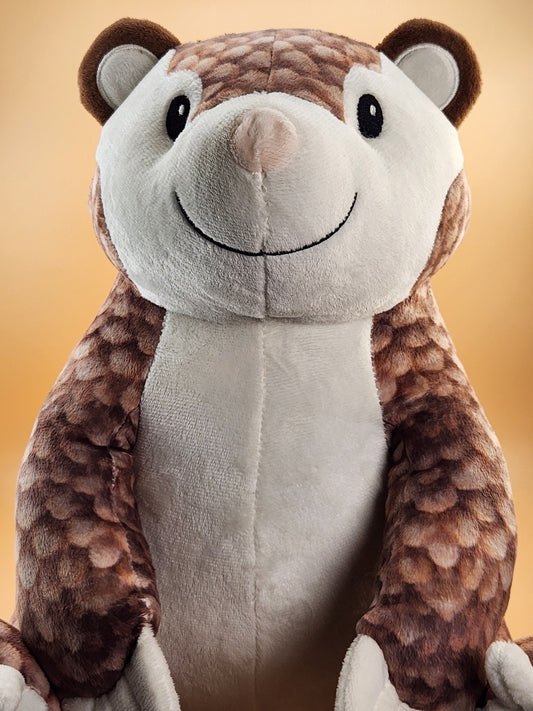
- Use a plush for storytelling: A toy like Paulie the Pangolin plush toy for kids can help children connect a surprising animal fact to kindness, curiosity, and real-world conservation.
That last part matters. When children care about an animal, they usually remember more about it, and they are more ready to help protect it.
2. Baby Pangolins Ride on Mom's Tail
Some animal babies hide in nests. Some ride on a parent's back. Pangolin babies do something children usually find unforgettable. They ride on their mother's tail.
That image sticks because it feels both gentle and smart. A baby stays close, stays safer, and gets carried while the mother moves through the habitat looking for food.
An easy way for kids to picture it
A simple comparison is a piggyback ride, but lower and steadier. Instead of sitting high on shoulders, the baby pangolin clings near the base of the mother's tail while she travels.
This is also a good place for empathy. A child can understand the feeling of staying close to a trusted grown-up in a busy place. Pangolin babies need that same closeness while they learn how the world works.
When kids learn animal facts through family relationships, they often remember them longer.
For younger children, this fact is enough on its own. For older children, it opens a wider conversation about how young animals learn. They don't just grow. They watch, follow, and practice.
A practical learning idea is pretend play. A parent can place a stuffed animal on the back of a larger plush and ask, “Why would a baby stay there instead of walking alone?” That turns a fact into a reasoning exercise.
For gift-givers and classrooms, Paulie the Pangolin from the Snugglebug conservation journal can support that kind of conversation. A child who hugs a pangolin plush while hearing about a mother and baby often forms a stronger emotional link to the animal itself.
Another good prompt is age-based:
- Ages 3 to 5: “Where is the baby riding?”
- Ages 6 to 8: “Why is riding safer than walking alone?”
- Ages 9 to 12: “How does staying close help a young animal learn survival skills?”
That kind of questioning helps children move from cute animal facts to deeper understanding.
3. Pangolins Have an Extra-Long, Sticky Tongue
A pangolin solves dinner in a very unusual way. It has no teeth, so its body uses a long, sticky tongue to gather ants and termites from narrow tunnels and nests.
That often surprises kids, and for good reason. The tongue sounds almost like a made-up superhero tool, but it is a real adaptation. An adaptation is a body feature that helps an animal live and find food.
How a toothless eater gets the job done
Because pangolins eat ants and termites, their feeding method is different from ours. The sticky tongue collects insects, and the food is processed farther down in the body. Some pangolins also swallow small bits of grit, and their stomach helps break food down, as explained in this video about how pangolins survive without teeth.
A simple comparison helps here. A straw helps reach the last sip at the bottom of a cup. A pangolin's tongue helps it reach bugs hidden deep inside tight spaces.
Kids often ask the next smart question right away. “If it doesn't chew, how does it still eat enough?” That question opens the door to a bigger science idea. Animal bodies are built for the jobs they need to do.
Families who want to connect this fact to a wider lesson about survival can read more in Snugglebug's animal behavior learning article.
After children picture that feeding method, this short video can help them connect the idea to movement and feeding behavior.
For older kids, this is also a good time to clear up a common mix-up. Pangolins may remind children of anteaters, but they are a different kind of animal with their own special tools and behaviors.
A small interactive moment can make this fact stick. Say the word together first: PAN go lin. Then ask a child to pretend their hand is a sticky tongue reaching into a pretend ant tunnel made from a paper towel tube. Learning becomes easier when kids can say it, see it, and act it out.
- For preschoolers: “A sticky tongue catches tiny bugs.”
- For ages 6 to 8: “The tongue helps reach food hiding in small spaces.”
- For ages 9 to 12: “This adaptation shows how an animal's body matches the food it eats.”
A plush can help here too. If a child uses Paulie the Pangolin from Snugglebug during pretend play, the lesson becomes more personal. Caring about an animal is often the first step toward wanting to protect it.
4. Pangolins Roll Into an Impenetrable Ball for Protection
When pangolins feel scared, they don't try to roar, chase, or wrestle. They curl up. That sounds simple, but it's a clever defense.
The overlapping scales create a protective outside layer while the softer parts stay tucked inside. It's a little like closing a treasure box before something can reach what's inside.
A simple home activity
Children understand this fact best with movement. They can crouch down, tuck in arms and legs, and pretend to be a pangolin protecting their belly. That turns a word like defense into something they can feel in their own body.
This is also a good chance to explain that animal behavior often matches body design. Pangolins have scales, and their rolling behavior works with those scales.
Learning link: Families can pair this fact with Snugglebug's animal behavior learning article to help children connect what animals do with why they do it.
A practical discussion can sound like this: “If an animal is small and shy, what helps more, fighting or protecting itself?” Children often arrive at the answer on their own.
For ages 4 to 7, keep it physical and simple. For ages 8 to 12, introduce the idea that behavior is part of survival, just like claws, scales, or camouflage are.
A quick game works well in a classroom or living room:
- Round 1: Stand tall like an animal that runs.
- Round 2: Curl small like a pangolin.
- Round 3: Talk about which body shape protects soft body parts better.
That kind of activity helps children remember that animals aren't “doing tricks.” They're using survival strategies.
5. Pangolins Are Nature's Pest Control
A pangolin spends much of its time doing a quiet job that helps the places where it lives. It eats ants and termites, which means it helps stop bug numbers from growing too fast.
That role is easier for kids to understand with a home example. If a few crumbs fall on the kitchen floor, ants can appear quickly. In forests and grasslands, insects can multiply fast too. Animals like pangolins help keep that natural balance steadier.
For younger children, a simple sentence works well: “Pangolins are bug-eaters that help nature.”
Older kids can go one step further and learn the idea of a food web. A food web is like a giant neighborhood chart showing who eats what, and how living things affect one another. Pangolins fit into that chart as insect-eaters. When one animal disappears, the whole system can feel the change.
This section also works well as a pronunciation pause for younger learners. Say it slowly together: PAN-guh-lin. Then connect the word to the job: “Pangolins eat pests.”
A simple sorting activity
This hands-on activity helps children remember what a pangolin does:
- Make three groups: animals that eat plants, animals that eat other animals, and animals that eat insects.
- Add the pangolin: place it with the insect-eaters.
- Ask one cause-and-effect question: “What could happen if a habitat had fewer animals that eat insects?”
That question builds science thinking in a gentle way. Children start to see that even shy animals have big jobs.
For ages 4 to 7, keep the lesson concrete. Pangolins eat bugs, and that helps nature.
For ages 8 to 12, you can add a conservation link. If pangolins disappear, their habitats lose one of the animals that helps control ants and termites. That makes protecting pangolins easier to understand, because saving an animal also helps protect the home around it.
Families can tie that idea to action through Snugglebug's mission of helping children learn about threatened wildlife with care and empathy. A toy like Paulie the Pangolin plush can give younger kids something to hold while they learn, which often makes the lesson feel more real and memorable.
6. There Are 8 Different Species of Pangolin
The pangolin family includes 8 different species, living in Africa and Asia.
That idea helps children grow from “pangolin” as one animal into “pangolins” as a whole family of related animals. It works like learning that cats include lions, tigers, and house cats. They belong to the same larger group, but they do not all live the same way.
For younger kids, the first big idea is simple. Some pangolins live in Africa, and some live in Asia.
For older kids, this becomes a great way to explore adaptation. Different species live in different habitats, so their bodies and behaviors suit the places where they survive best. Some spend more time on the ground. Some are better climbers and spend more time in trees. That gives children a clear science lesson. Even close animal relatives can solve the same problem in different ways.
A kid-friendly sorting game
Instead of asking children to memorize every species name at once, start with sorting. Make two groups labeled Africa and Asia. Then add pangolin pictures or paper cutouts to each group.
A map makes this even easier to understand. Children can color Africa one color and Asia another, then place each pangolin in the right region. Now the lesson connects animal science and geography at the same time.
If your child likes words, add a quick pronunciation moment with the species idea. Say PAN-guh-lin together, then explain that one word names a whole group, not just one single kind. That small pause can help younger learners hold onto the new idea.
Older children often enjoy this because it feels a bit like the work scientists do. Scientists sort living things into groups so they can understand how animals are alike and how they are different.
For ages 5 to 7, “pangolins live in different parts of the world” is enough.
For ages 8 to 12, you can go further and ask questions like, “Why might a tree-climbing pangolin need different skills than one that spends more time on the ground?” That turns a fact into a conversation.
Families can also connect this lesson to empathy. When children learn that there are several kinds of pangolins, they start to see wildlife as a whole community, not just a single cute animal. Snugglebug's mission fits naturally here by helping families connect learning with care for threatened species, and a Paulie the Pangolin plush can give younger children a friendly, hands-on way to remember that each species matters.
7. Pangolins Are Shy, Solitary, and Nocturnal
A pangolin's day often begins when your family's day is ending. While children are putting on pajamas and turning out the light, a pangolin may be waking up and getting ready to search for food.
That helps explain why pangolins can seem mysterious. Their quiet habits keep them out of sight. They usually spend time alone, and they do much of their moving around at night.
The word nocturnal means “active at night.” The word solitary means “living alone most of the time.” Those are helpful science words for kids to learn because they describe how an animal survives, not just what it looks like.
A simple way to teach this is with a day-and-night sort. Put a butterfly, squirrel, or chicken in the “day” group. Put an owl and a pangolin in the “night” group. Younger children can understand the idea quickly when they can see the comparison.
Older children can go one step further and ask why this behavior might help. Night can offer cooler temperatures and fewer disturbances. A shy animal also stays safer when it keeps a low profile, much like a child who chooses a quiet corner instead of the busiest part of the playground.
These habits also make pangolins harder for scientists and wildlife protectors to study. An animal that is active after dark and spends time alone leaves fewer chances for people to observe it. That is one reason conservation takes patience, careful tracking, and long-term support, including projects connected to pangolin conservation funding and protection efforts.
Best for different ages
- Ages 3 to 5: Sort animals into “awake in the day” and “awake at night.”
- Ages 6 to 8: Practice saying nocturnal and solitary, then use each word in a sentence.
- Ages 9 to 12: Talk about how being shy and active at night can make an animal harder to protect.
Try a small hands-on activity at home. Turn the room lights low, hide a few paper “ants” around the floor, and let your child pretend to be a pangolin searching in the dark. If they have a Paulie the Pangolin plush, they can use it during the game and connect play with empathy.
Snugglebug's mission fits naturally here. Children learn that some animals need peace, space, and protection even when people rarely see them. That lesson builds both knowledge and kindness.
8. Pangolins Are the World's Most Trafficked Mammal

A child who has just learned that pangolins carry babies on their tails or curl into a tight ball may ask a hard question next. If pangolins are so special, why do they need so much help?
WWF describes pangolins as the world's most heavily trafficked wild mammal, with more than 1,000,000 pangolins trafficked over a 10-year period. For families, that fact is usually enough to show that the problem is serious.
It helps to explain this gently. Some people capture pangolins and remove them from the wild, which hurts pangolins and makes it harder for their populations to recover. A shy animal that already hides well can disappear even faster when people take it from its home.
A gentle conservation conversation
For younger children, keep the language simple and safe. You might say, “Pangolins belong in the wild, and some people take them away. Wildlife helpers are working to protect them.” That gives children the truth in a calm, manageable way.
Older children can handle a little more context. You can explain that pangolins need protection from illegal wildlife trade, and that scientists, park rangers, and conservation groups are trying to keep them safe. This turns a sad fact into a lesson about helpers, responsibility, and courage.
A useful comparison can make this clearer. If a library kept losing books faster than it could replace them, the shelves would slowly empty. Pangolin populations face a similar problem when too many animals are taken from the wild.
Children understand conservation best when it stays personal. Learn about the animal, care about the animal, then help protect its home.
Families who want to turn concern into action can read about pangolin conservation funding and protection efforts. That keeps the focus on real helpers and real solutions. A child hugging a Paulie the Pangolin plush can also be reminded that caring about animals is a starting point for protecting them.
Best for different ages
- Ages 3 to 5: Practice the phrase “Pangolins need to stay safe in the wild.”
- Ages 6 to 8: Talk about what a wildlife helper does, such as protecting animals or their homes.
- Ages 9 to 12: Discuss why illegal trade is harmful and how laws, rescues, and education can help.
Try one hands-on activity. Draw two circles on paper labeled “Things that hurt pangolins” and “Things that help pangolins.” Then let your child sort picture cards or words into each group. It is a simple way to build understanding, empathy, and action at the same time.
Compare 8 Pangolin Facts for Kids
| Item | 🔄 Complexity (process) | ⚡ Resources (speed/efficiency) | 📊 Expected outcomes (results) | 💡 Ideal use cases (insights/tips) | ⭐ Key advantages (quality) |
|---|---|---|---|---|---|
| Pangolins Are Covered in Protective Scales (Not Fur!) | Low, simple visual explanation and comparison | Photo or textured plush; one short demo | Understand morphological adaptation and keratin composition | Preschool introduction to animal adaptations | Highly visual, memorable example of physical defense |
| Baby Pangolins Ride on Mom's Tail | Low, anecdotal story plus image works well | Photo or short clip; plush for role-play | Build empathy; illustrate parental care and development | Preschool lessons on families and safety | Relatable, emotionally engaging behavior example |
| Pangolins Have an Extra-Long, Sticky Tongue | Medium, needs demonstration or animation to convey scale | Video/screenshot, diagram, or live demo props | Explain feeding specialization and anatomical adaptation | Early elementary biology: form fits function | Striking, curiosity-driving example of specialization |
| Pangolins Roll Into an Impenetrable Ball for Protection | Medium, best shown with video or interactive plush demo | Photo/video plus curlable plush or model | Teach passive defense and trade-offs (vulnerability to poaching) | Early elementary behavior lessons and hands-on demos | Clear, teachable defensive behavior that's interactive |
| Pangolins Are Nature's Pest Control | Medium, benefits from stats and ecosystem context | Infographic or activity with numbers and comparisons | Convey ecological role, ecosystem services, food-chain links | Early elementary environmental science and ecology units | Quantifiable ecosystem impact; connects species to habitat health |
| There Are 8 Different Species of Pangolin | Medium–High, requires maps and species comparisons | Infographic, concept map, species images | Teach biodiversity, geographic distribution, adaptation differences | Older kids studying biodiversity and evolution | Demonstrates diversity within a single taxonomic group |
| Pangolins Are Shy, Solitary, and Nocturnal | Medium, abstract behavior needs evidence-based examples | Camera-trap photos, night imagery, researcher notes | Introduce animal behavior, research challenges, sensory adaptation | Older kids: conservation research and scientific methods | Highlights scientific discovery challenges and niche behavior |
| Pangolins Are the World's Most Trafficked Mammal | High, sensitive topic needing careful framing and context | Infographics, vetted conservation links, discussion guides | Raise awareness of threats; motivate conservation action | Older kids: ethics, conservation, activism lessons | Urgent real-world relevance; drives action and policy discussion |
How Your Family Can Help Save Pangolins
Pangolins are unusual, gentle, and important to nature. They also need human help. A good conservation lesson for children should end with hope, because hope turns caring into action.
One simple action is sharing what's been learned. A child who tells a grandparent, classmate, or neighbor one pangolin fact is already helping more people notice an animal many have never heard of. Awareness matters because animals that stay invisible are easier to ignore.
Another practical step is choosing learning tools that keep wildlife in everyday family life. A species-specific plush, a fact card, or a short nature conversation at bedtime can help children remember that pangolins are real animals, not just strange pictures in a book. If a family chooses a mission-driven option such as Snugglebug and Paulie the Pangolin, that can make the lesson feel concrete and comforting at the same time.
Families can also follow real conservation groups and talk about what protectors do. WWF is one well-known example. Children often feel calmer and more reassured when adults emphasize that many people are already working to protect animals in the wild.
A good home routine might look like this:
- Share one fact: Ask each child to tell one new pangolin fact at dinner.
- Practice pronunciation: Say pan-guh-lin together until it feels easy.
- Make a simple craft: Try paper scales, a drawing, or a small pangolin puppet.
- Connect fact to feeling: Ask, “What makes this animal special?” and “Why does it deserve safety?”
- Support real protectors: Read about conservation work and talk about how helpers protect habitats and stop illegal wildlife trade.
Children learn best when facts connect to empathy. A pangolin isn't just the mammal with scales. It's also a shy nighttime animal, a bug-eater that helps ecosystems, a baby that rides with its mother, and a species that needs people to care.
That's why pangolin facts for kids can be so powerful. They start with wonder, then grow into kindness and responsibility. When a child remembers the scales, the sticky tongue, or the curled-up ball shape, that memory can become the beginning of conservation.
Snugglebug offers wildlife-themed plush toys and educational resources that help families turn playtime into animal learning. For children who connected with these pangolin facts for kids, Snugglebug and Paulie the Pangolin can be one gentle way to keep that curiosity and care going at home.