8 Amazing Snow Leopard Facts for Kids

8 Amazing Snow Leopard Facts for Kids

A child studies a snowy mountain photo, eyes scanning the rocks, and suddenly spots a snow leopard almost hiding in plain sight. That instant feels a bit like finding a secret written into the mountain itself. Curiosity turns into attention, and attention turns into care.

Snow leopard facts for kids can do more than fill a page with interesting details. They can help children notice how animals survive, ask better questions, and understand why protecting wild places matters. For parents and educators, that makes this topic especially rich. One fact can become a movement game, a drawing challenge, a family discussion, or a simple lesson about conservation.

High in the mountains of Central and South Asia, snow leopards live in cold, rocky places that seem almost built to hide them. Their thick fur, wide paws, long tails, and quiet movement help them live where few people ever go. To a child, that mystery is part of the magic. To an adult, it is also a wonderful teaching tool.

A snow leopard's body works like a set of mountain survival tools. Each feature has a job. Some help the cat stay warm. Others help it climb, balance, or disappear against stone and snow. When children learn facts in that connected way, they do not just memorize them. They start to see how habitat, body design, and behavior fit together.

That is what makes this guide useful at home or in the classroom. A camouflage fact can become a hide-and-seek activity with patterned paper. A lesson about paws can turn into a footprint experiment in flour or sand. A conversation about danger in the wild can grow into a thoughtful talk about how people can help animals keep their homes.

Table of Contents

1. Snow Leopards Are the Mountains' Invisible Ghosts

A child scanning a rocky mountain photo often misses the snow leopard at first. Then the spots, pale fur, and crouched shape suddenly appear, and the whole picture changes. That moment teaches one of the most memorable snow leopard facts for kids. This big cat is built to fade into its home.

Its coat works like natural mountain camouflage. The smoky gray fur blends with stone, snow, and shadow, while the dark rosettes break up the outline of the body. To a prey animal looking uphill or across a cliff, a snow leopard may look like part of the hillside instead of a hunter.

A camouflage-patterned snow leopard peeking out from behind a snow-covered rocky mountain slope in the wilderness.

Snow leopards also live in vast, rugged mountain areas, which makes sightings rare. Kids sometimes assume "invisible ghost" means magical. It is better to explain it step by step. The cat is hard to see because its colors match the land, its body stays low, and its habitat gives it many places to hide.

Why they seem to disappear

This fact becomes much stronger when children test it with their own eyes. Show a photo of a snow leopard in a rocky setting and let kids search before you point it out. Once they find it, ask what made the animal hard to spot. Most children will notice the color first. Fewer will notice the body shape and the shadows.

Try one of these simple teaching ideas:

  • Seek-and-find challenge: Print a mountain picture and ask children to circle the snow leopard.
  • Compare big cat coats: Place images of a lion, tiger, and snow leopard side by side. Ask which one would hide best in snow and rock, and why.
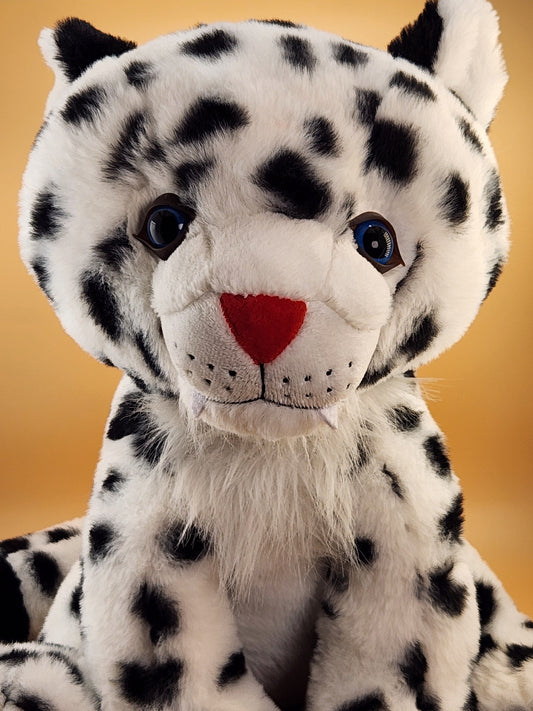
  • Use a plush toy: A toy like Tashi the Snow Leopard helps younger children notice thick fur, spots, and coloring. Then place the toy near gray blankets, pillows, or rocks outside and see how quickly it blends in.

Practical rule: If a child has to search carefully, camouflage becomes something they understand, not just a word they memorize.

Parents and teachers can turn this into a conservation lesson too. Camouflage only works when the habitat still looks and functions the way the animal needs. If mountain environments change, hiding gets harder, hunting gets harder, and survival gets harder. That helps children connect one exciting fact to a bigger idea. Protecting animals also means protecting the places that make their special adaptations useful.

2. Their Super-Long Tails Are Like Built-In Scarves and Balance Beams

A snow leopard's tail is one of its most striking features. It looks soft and dramatic, but it isn't just for show. That tail helps the cat stay steady on steep ledges and keep warm in bitter mountain weather.

Children usually understand this best through comparison. A scarf keeps a person warm. A balance beam trains the body to stay steady. A snow leopard's tail does both jobs in one furry tool.

That idea is fun because it makes the animal feel brilliantly designed for its home. Every body part has a purpose.

A simple at-home activity

This lesson doesn't need special supplies. A scarf, a piece of string, or even a rolled-up blanket can turn the fact into play.

  • Wrap and imagine: Let children wrap a scarf around their shoulders while sitting still. Then ask why a mountain cat might want extra warmth while resting on snow.
  • Balance practice: Place a line of tape on the floor and have children walk heel to toe with arms out. Then ask how a tail could help on a narrow mountain path.
  • Draw a survival diagram: Have kids label a snow leopard picture with “tail for warmth” and “tail for balance.”

A parent or teacher can also connect this idea to movement outdoors. Walking on a log, a curb, or stepping stones shows how much the body relies on balance. That helps children picture a snow leopard crossing rock ledges high above snowy valleys.

A strong animal doesn't survive by strength alone. It survives by using every adaptation well.

For younger learners, this is also a good place to talk about observation. Ask what features stand out on Tashi the Snow Leopard or in a wildlife photo. Often, children notice the tail first. That makes it an easy entry point into a broader discussion about animal adaptation.

3. Snow Leopards Can Jump Across Harsh Mountain Gaps

Snow leopards live in a world of cliffs, boulders, and narrow ledges. Their bodies have to handle sudden changes in height and uneven ground. That makes them excellent jumpers and climbers, even if a lesson doesn't need exact measurements to feel impressive.

A child can understand this quickly with a playground comparison. Crossing from one rock to another in the mountains is a bit like moving across monkey bars, stepping stones, and balance beams all at once. The difference is that the snow leopard is doing it in cold, wild terrain.

This fact works best as a movement lesson. Instead of only reading about mountain agility, children can try safe, ground-level versions of it.

Turn movement into learning

A backyard, classroom, or living room can become a “mountain path” with pillows, chalk marks, or paper spots on the floor.

  • Build an obstacle path: Use cushions or paper circles as “rock ledges.” Children can step, stretch, and jump from one to the next.
  • Practice careful landing: Encourage soft knees and quiet feet to model how wild animals move with control.
  • Add decision-making: Ask children which path looks safest. That brings in the idea that animals must judge space, footing, and risk.

A short video can help children connect the game to the actual animal. This clip gives a visual sense of how power and balance work together in mountain terrain.

Children often enjoy pretending they're the animal, but the deeper lesson is about habitat. Snow leopards need connected mountain spaces where they can move, hunt, and travel safely. Broken or disturbed habitat makes movement harder for an animal built for open, rugged ground.

4. Snow Leopards Face Real Dangers in the Wild

Not every snow leopard fact for kids should sound cute or easy. Children can handle honest conservation lessons when adults use clear language and real-world examples. Snow leopards face serious threats, and those threats include more than poaching or habitat loss alone.

One especially important point is often left out of simple children's materials. Snow leopards are also killed when they prey on sheep and goats, which can make local families feel that the cats threaten their livelihoods. The David Shepherd Wildlife Foundation's snow leopard facts for kids page explains that human-wildlife conflict, loss of prey, poaching, habitat loss, and climate change are all major threats.

That changes the conversation in a useful way. Protecting snow leopards isn't only about “saving a beautiful cat.” It's also about helping people protect their animals, income, and daily lives.

A more honest conservation lesson

This is a strong discussion prompt for older children. Ask, “What happens when people and wild animals need the same space?” That question leads to empathy on both sides.

  • Use role play: One person can act as a herder protecting goats. Another can act as a conservationist. Another can act as a snow leopard looking for food.
  • Map the problem: Draw a mountain, a village, grazing animals, and a snow leopard path. Then ask where conflict might happen.
  • Focus on solutions: Talk about helping both people and wildlife, not choosing one over the other.

For families that want a simple next step, Snugglebug's journal article on why snow leopards are endangered offers a kid-friendly starting point for that conversation.

Protecting wildlife works best when people living near that wildlife are part of the solution.

This item often becomes the most meaningful one. It teaches children that conservation is not only about loving animals. It's also about fairness, problem-solving, and helping communities live alongside them.

5. Snow Leopards Roar, Chirp, and Meow in Their Own Way

Children often assume every big cat roars like a lion. Snow leopards are a great reminder that animals in the same broad family can still communicate differently. Their sounds can feel surprisingly gentle compared with the booming calls children might expect.

That makes this fact playful. It invites listening, guessing, and sound matching. It also helps children understand that communication fits an animal's environment and behavior.

A mountain cat that lives alone most of the time doesn't need to sound exactly like a cat on open grasslands. Even without leaning on exact sound labels as hard facts, parents can explore the wider idea that snow leopards use their own mix of vocal signals.

A sound game for kids

This section works well as an ear-training activity.

  • Compare animal voices: Play recordings of a lion, house cat, and snow leopard from a trusted educational source. Ask which one sounds most surprising.
  • Make a sound chart: Write headings like “soft,” “sharp,” “friendly,” and “warning.” Let children sort sounds into categories.
  • Act out messages: One child can make a gentle call for “hello,” another a warning sound for “stay back.”

This opens a useful science idea too. Animals communicate for different reasons. They may want to warn, attract, comfort, or locate one another. A child who starts listening for purpose is already thinking like a young naturalist.

A practical classroom example is circle time. One sound can mean “gather.” Another can mean “freeze.” Children quickly learn that sound carries meaning. Snow leopards do the same in their own world.

6. Snow Leopards Are Solitary Mountain Wanderers Who Need Huge Territories

At first, children may picture every big cat living in a family group. Snow leopards help correct that idea. These mountain cats usually live alone, crossing rocky slopes and snowy valleys with a great deal of space between one animal and the next.

That large home range makes sense once kids picture the setting. A snow leopard does not live in a flat backyard-sized habitat. It moves through a sprawling mountain world where prey can be scattered, paths can be steep, and safe resting places may be far apart. Space is part of survival.

A helpful comparison works like this. One child may spend most days moving between a bedroom, kitchen, yard, and school. A snow leopard's "daily neighborhood" can stretch across ridges, cliffs, and valleys. The cat has to travel to hunt, avoid danger, and find routes through a hard terrain.

Helping kids picture a giant home range

Try a map-and-movement activity instead of only reading the fact aloud. Start with a place your child knows well, such as your home, a playground, or the route to school. Then zoom out to a mountain region on a map and ask, "How many playgrounds would fit inside a wild cat's roaming area?" Kids quickly notice that wild animals often need far more room than people do.

  • Trace a route: Draw a simple path over pretend mountains on paper and let children mark where a snow leopard might rest, hunt, or hide.
  • Compare spaces: Measure your living room or yard, then talk about why a large predator cannot live in a tiny patch.
  • Spot interruptions: Add roads, fences, or villages to the drawing and ask how those obstacles could break up an animal's travel route.

This can open a strong conservation lesson. If animals that live alone still need lots of connected land, habitat loss becomes easier for children to understand. The problem is not only where an animal sleeps. It is whether it can move safely from one part of its world to another.

For a broader teaching extension, Snugglebug's article on animal behavior learning for families and educators gives adults more ways to connect behavior, habitat, and observation.

A gentle discussion prompt can make this memorable. Ask children, "Do you feel like being around people all the time, or do you sometimes want quiet space?" Then connect that feeling to wildlife carefully. Snow leopards are not lonely in the human sense. They are adapted for independence, distance, and life in the high mountains.

7. Baby Snow Leopards Stay Close to Mom for a Long Time

One of the warmest snow leopard facts for kids is also one of the easiest to connect to family life. Snow leopard cubs don't become independent right away. They need time, practice, and protection while they learn how to survive in a difficult mountain home.

That long learning period makes sense when children think about the skills involved. A cub has to move on rocky slopes, stay hidden, follow its mother, and slowly figure out how to live in cold, dangerous terrain. Mountain life doesn't allow rushed lessons.

The emotional connection matters here. Children understand what it means to learn from a parent or caregiver. That makes the bond between a mother snow leopard and her cubs especially memorable.

A mother snow leopard looking protectively at her two small, grey spotted cubs inside a rocky den.

A family-centered discussion prompt

This item works well in story form. Ask children what a cub might need to learn before living on its own. The answers often come quickly: where to go, what to eat, how to stay safe.

  • Make a cub lesson list: Children can draw pictures for “climb,” “hide,” “follow,” and “rest.”
  • Compare childhoods: Talk about how human children also need years of teaching, food, safety, and care.
  • Create a den corner: Use blankets and pillows to make a pretend snow leopard den for dramatic play.

This section can also support conversations about protection. Young animals are especially vulnerable when habitats are disturbed. If a family group loses safety, the next generation faces a harder path.

A cub doesn't only inherit a body suited to the mountains. It also needs time with its mother to learn how to use that body well.

That message helps children move beyond “baby animals are cute” toward “baby animals need stable homes and caregiving.” That's a valuable conservation lesson.

Compare 8 Snow Leopard Facts for Kids

After learning each fact on its own, many children benefit from seeing the big picture in one place. A comparison table works like a field guide summary. It helps parents and teachers quickly choose which fact fits a quiet read-aloud, an active game, a science talk, or a conservation conversation.

Fact / Title Easy Way to Teach It Simple Materials What Kids Learn Best For Family or Classroom Follow-Up
Snow Leopards Are the Mountains' Invisible Ghosts Show a snow leopard photo and ask children to spot the body against the rocks Photo, printed image, or short video clip Camouflage helps animals stay hidden in their habitat Storytime, nature lessons, museum-style observation Try a hide-and-find picture activity with patterned animals
Their Super-Long Tails Are Like Built-In Scarves and Balance Beams Use a scarf or rope to show how a tail can help with warmth and balance Scarf, rope, or stuffed animal with a tail Body parts can do more than one job Hands-on learning, movement breaks, sensory play Walk along a line while holding a scarf behind the body for balance
Snow Leopards Can Jump Across Harsh Mountain Gaps Measure a short gap on the floor and talk about why strong legs matter in rocky places Tape, cushions, or floor markers Mountain animals need powerful movement to travel safely Active lessons, outdoor play, habitat discussions Make a pretend mountain path with safe stepping spots
Snow Leopards Face Real Dangers in the Wild Use a map or simple pictures to discuss habitat change, conflict, and conservation Map, animal range image, age-appropriate discussion cards Wild animals need safe places to live and enough prey to survive Conservation lessons, family discussions, service projects Ask, "What do animals need from people to stay safe?"
Snow Leopards Roar, Chirp, and Meow in Their Own Way Compare animal sounds and sort them by loud, soft, or surprising Audio clips or teacher-made sound examples Animals communicate in different ways for different reasons Circle time, sound activities, early science learning Have children match a sound to a feeling or purpose
Snow Leopards Are Solitary Mountain Wanderers Who Need Huge Territories Spread objects far apart to show how one animal may move through a large area alone Cones, toys, or paper markers Some animals need lots of space, even if they do not live in groups Geography lessons, movement games, ecology talks Build a floor map showing food, shelter, and travel routes
Baby Snow Leopards Stay Close to Mom for a Long Time Use a story or pretend play to show how cubs learn by staying near their mother Blankets, toy animals, drawing paper Young animals need care, safety, and time to learn Family learning, dramatic play, caregiving discussions Make a "what a cub must learn" picture list
Snow Leopards Have Built-In Snow Boots Test wide "paws" on soft surfaces to feel how weight spreads out Paper ovals, socks, pillows, or crumpled paper Wide, furry paws help with walking on snow and rough ground Sensory activities, winter units, adaptation lessons Create paw prints and follow a trail across the room

This table is most useful when it leads to action. Instead of asking, "Which fact is your favorite?" try, "Which fact should we test, act out, draw, or discuss today?" That one small shift turns a list of facts into a family learning plan.

Compare 8 Snow Leopard Facts for Kids

Fact / Title Implementation Complexity 🔄 Resource Requirements ⚡ Expected Outcomes 📊 Ideal Use Cases 💡 Key Advantages ⭐
Snow Leopards Are the Mountains' Invisible Ghosts Low, show photos/videos Low, images, short clips High engagement; teaches camouflage Intro lessons, storytime, exhibits Visually compelling; explains adaptation
Their Super-Long Tails Are Like Built-In Scarves and Balance Beams Low, simple demos Low, scarf/rope, plush tail Tangible understanding of multifunctional tail Hands-on activities, crafts, sensory play Memorable, relatable physical trait
Snow Leopards Can Jump Higher Than Any Big Cat, Up to 6 Times Their Body Length Medium, space or video demos Medium, measuring tape, obstacle course, slow‑mo video Excitement; conveys athletic adaptation & habitat needs PE activities, active learning, conservation talks Dramatic, teaches habitat connectivity
Snow Leopards Are Endangered Because of Climate Change and Habitat Loss Medium‑High, careful framing needed Medium, maps, age‑appropriate materials, support resources Increased conservation awareness; possible emotional response Conservation education, fundraising, civic lessons Motivates action; links behavior to impact
Snow Leopards Roar, Chirp, and Meow, But Rarely Use Their Famous Roar Low, play audio & compare Low, sound clips, comparison recordings Builds approachability; teaches communication differences Audio lessons, zoo programs, science comparisons Unique vocal profile; engaging audio content
Snow Leopards Are Solitary Mountain Wanderers Who Need Huge Territories Medium, spatial concepts & mapping Medium, maps, GPS examples, visuals Understanding of territory, fragmentation effects Geography lessons, habitat fragmentation units Explains scale of protection needed
Baby Snow Leopards (Cubs) Stay With Mom for About 2-3 Years, The Longest of Any Big Cat Low‑Medium, sensitive storytelling Low, photos, stories, timelines Strong emotional connection; highlights slow recovery Family‑oriented lessons, empathy activities Personalizes conservation; fosters care
Snow Leopards Are Perfect Hunters With Thick Pads on Their Feet, Like Built-In Snow Boots Low, tactile demos & comparisons Low, plush paws, boot analogies, props Clear illustration of physical adaptation Tactile learning, science demos, classroom shows Concrete analogy; easy to demonstrate

Turn Facts into Action How Your Family Can Help

Learning about snow leopards can begin with a photo or a plush toy, but it shouldn't stop there. The strongest wildlife lessons happen when a fact turns into a conversation, a game, a drawing, or a choice. That's how children move from memorizing information to caring about a real animal in a real place.

Each of these snow leopard facts for kids can become a hands-on moment. Camouflage can become a hide-and-seek challenge with printed mountain pictures. Tails can become a balance activity with scarves and floor tape. Paws can become painted footprints across paper snow. When learning feels active, children remember more and ask better questions.

Conservation learning also grows when adults keep the story honest. Snow leopards aren't only mysterious and beautiful. They also live in areas where people raise animals, protect homes, and depend on the land. Teaching children about conflict, habitat, and problem-solving helps them see conservation as something practical and humane.

Parents and educators don't need to be wildlife experts to make this meaningful. A globe, a map, a short discussion at bedtime, or a pretend mountain obstacle course can do the job. What matters most is the habit of wondering out loud. Why is the tail so long? Why does camouflage matter? Why might a herder worry about losing sheep or goats? Those questions build empathy and critical thinking at the same time.

This kind of learning can also be supported with objects children return to often. A species-themed plush such as Tashi the Snow Leopard can give younger children a familiar way to revisit what they've learned, especially when paired with stories, drawing time, or simple conservation conversations. For families who want purchases to reflect those values, Snugglebug states that it donates 15% of profits to vetted conservation organizations and related sustainability efforts.

Snow leopards may live far away in high mountain regions, but the habit of caring for them can begin at home. A child who learns to notice adaptation, respect wild spaces, and think about how people and animals share the world is already practicing conservation. That's a meaningful beginning, and it lasts longer than a single fact ever could.


Families who want to turn playtime into wildlife learning can explore Snugglebug and its species-themed plush toys, including Tashi the Snow Leopard, as one way to support conversations about animals, empathy, and conservation at home.

Back to blog